How to Actually Track ROI on Your Performance Marketing (Without Losing Your Mind)
Let's be real: you're spending real money on Meta ads and Google campaigns, and at some point, someone (maybe you, maybe a board member, maybe just your own anxious brain at 11pm) is going to ask, "Is any of this actually working?"
The good news? You can answer that question confidently. The not-so-great news? Most founders are measuring the wrong things — or measuring the right things the wrong way. Let's fix that.
First, Get Clear on What ROI Actually Means for Your Business
ROI isn't just "did we make money?" It's a ratio:
ROI = (Revenue from channel – Cost of channel) ÷ Cost of channel × 100
But in ecommerce, there are a few more nuanced cuts of this that you'll want to track:
ROAS (Return on Ad Spend) is what the platforms show you. It's revenue divided by ad spend. If you spent $1,000 and drove $4,000 in sales, your ROAS is 4x. Simple, but incomplete — it doesn't account for cost of goods, fulfillment, or any other expenses.
MER (Marketing Efficiency Ratio) is the one smart operators swear by. It's total revenue divided by total ad spend across all channels. This is your true north star because it doesn't get fooled by attribution games between platforms.
CAC (Customer Acquisition Cost) is total ad spend divided by the number of new customers acquired. This matters enormously for your long-term unit economics, especially when you factor in LTV (lifetime value).
Start tracking all three. They tell different parts of the story.
The Attribution Problem (And Why You Can't Trust What Meta and Google Tell You)
Here's the dirty secret of performance marketing: Meta and Google are both claiming credit for the same sales. If a customer saw a Meta ad, then Googled your brand name and clicked a search ad before buying, both platforms will count that as a conversion in their dashboards. Your actual revenue gets double — or triple — counted.
This isn't a bug. It's just how last-click and platform-native attribution works.
So what do you do? A few things:
Use your Shopify (or ecommerce platform) revenue as your source of truth. Whatever your store reports as total revenue is what actually happened. Compare that to what your ad platforms are claiming, and you'll quickly see the discrepancy.
Run a blended view. Pull your total ad spend across Meta and Google, then divide it by your total store revenue for the same period. That's your blended ROAS or MER. It removes the attribution noise entirely.
Lean on Meta's Conversion API (CAPI) and Google's enhanced conversions. These don't fix attribution, but they do improve the accuracy of the signals you're sending back to the platforms — which means better optimization and more reliable in-platform reporting over time.
Setting Up Tracking the Right Way
Before you can measure ROI, your tracking infrastructure has to be solid. This is where a lot of brands have silent leaks.
Google Analytics 4 (GA4) is non-negotiable. Make sure it's connected to your store and that your purchase events are firing correctly. Use the DebugView to verify. If you're on Shopify, use the Google & YouTube sales channel to connect them properly.
Meta Pixel + Conversion API. The Pixel alone isn't enough anymore — iOS privacy changes gutted its effectiveness. CAPI sends conversion data server-side, which bypasses browser-level blocking. Most ecommerce platforms have a native CAPI integration or there are apps that can handle it for you.
UTM parameters on every ad. Every URL you're driving traffic to should have UTM parameters: source, medium, campaign, and content at minimum. This lets GA4 (and your email platform, etc.) properly attribute traffic back to its source. Without UTMs, you'll see a lot of mysterious "direct" traffic that's actually coming from paid channels.
Google Ads conversion tracking. Import your GA4 purchase goal into Google Ads rather than relying on the Google Ads tag alone. This keeps your attribution consistent and gives the algorithm better data to optimize against.
The Metrics That Actually Matter by Channel
Meta (Facebook & Instagram Ads)
The platform metrics to watch:
Cost per purchase — what you're paying for each sale, in-platform
Purchase ROAS — their reported return (remember: take this with a grain of salt)
CPM (cost per 1,000 impressions) — a good proxy for audience saturation and creative fatigue
CTR (click-through rate) — if this drops, your creative is getting stale
Frequency — if this climbs above 3-4, your audience is seeing your ads too much
The metrics to verify outside the platform:
New customer acquisition rate — are you actually getting new customers, or retargeting existing ones?
Blended ROAS vs. in-platform ROAS — the gap between these tells you how much overlap there is with other channels
Google Ads (Search & Shopping)
ROAS by campaign — search and shopping typically perform very differently; measure them separately
CPC (cost per click) — especially on branded vs. non-branded terms; branded search is usually efficient, non-branded is where it gets expensive
Impression share — are you showing up as often as you should be for your top keywords?
Quality Score — a low QS means you're paying more per click than you should be; it's a signal to improve landing page relevance
Conversion rate by campaign — traffic is only worth what it converts at
One important nuance for Google: separate your branded and non-branded campaigns and measure them differently. Your branded search ROAS will almost always look amazing because people are already looking for you — that's not incremental. Non-branded is where you're actually winning new demand.
How to Build a Simple ROI Dashboard
You don't need a fancy tool to start. A well-structured spreadsheet can get you 80% of the way there.
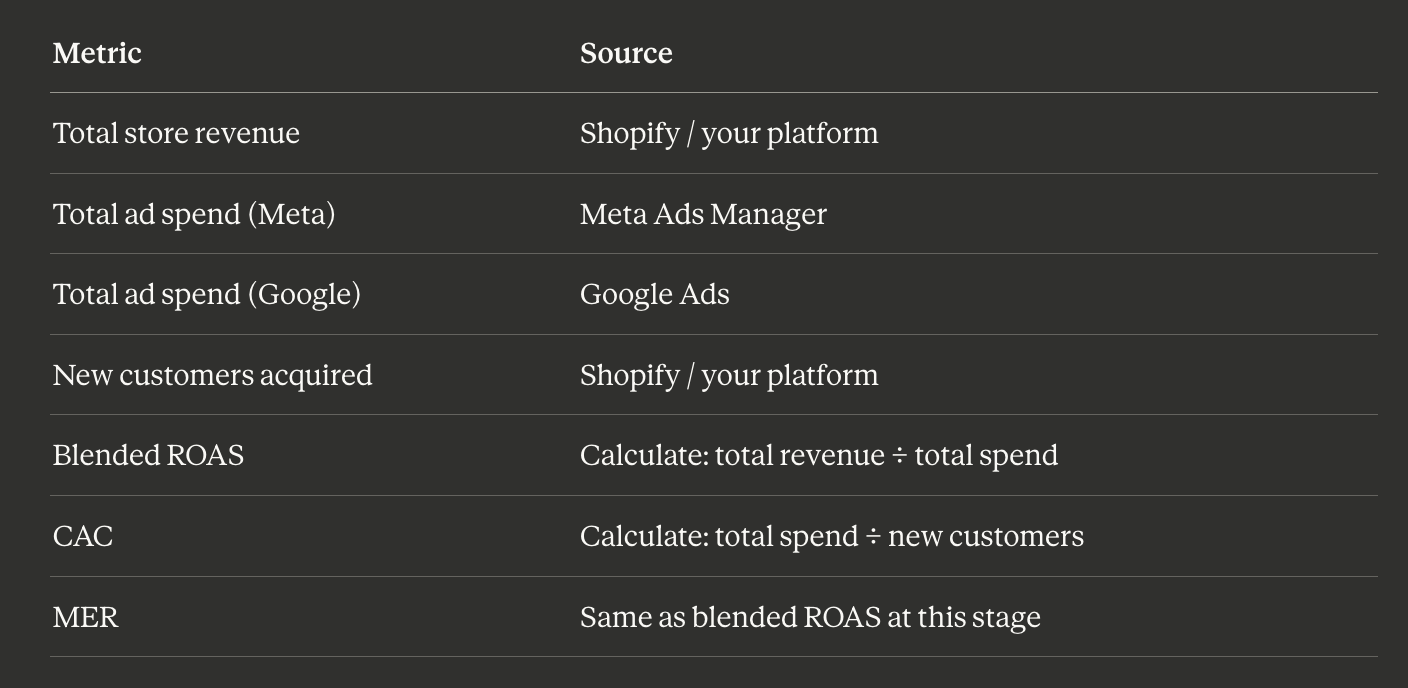
Here's what to pull weekly:
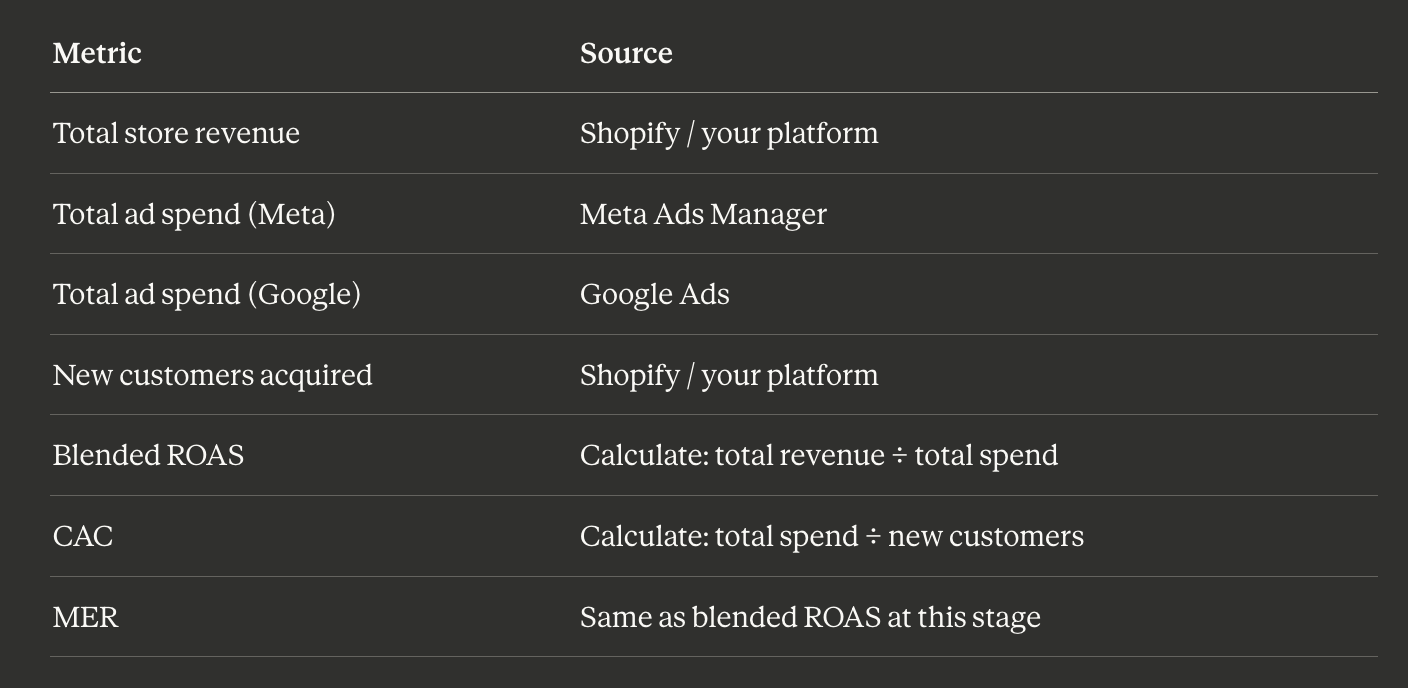
Review this weekly. Look for trends over time more than individual weekly spikes — one bad week doesn't mean your strategy is broken, but three in a row does.
If you want to go a step further, tools like Triple Whale, Northbeam, or Rockerbox are built specifically for ecommerce attribution and give you a much cleaner picture across channels. They're not cheap, but once you're spending $10k+/month on ads, they pay for themselves in better decision-making.
The Questions You Should Be Able to Answer
A healthy performance marketing setup should let you answer these at any point:
What is my blended ROAS this month, and how does it compare to last month?
What is my CAC, and does it make sense given my average order value and expected LTV?
Which channel is driving more new customers vs. re-engaging existing ones?
If I turned off Meta ads tomorrow, what would happen to my Google numbers? (This tells you about channel dependency and halo effects.)
Am I growing revenue because I'm spending more, or because my efficiency is improving?
If you can't answer these, that's not a marketing problem — it's a measurement problem. And measurement problems are very fixable.
A Note on Patience and Statistical Significance
One of the most common mistakes founders make is pulling the plug on a campaign too fast (or doubling down too fast) based on a few days of data. Performance marketing has a lot of noise in it — day of week, time of month, seasonality, creative fatigue, even news cycles can all move your numbers.
Give campaigns at least 2–4 weeks before drawing conclusions. Give channels at least a full quarter. And when you're comparing time periods, make sure you're controlling for seasonality — don't compare November to February and wonder why things look different.
The Bottom Line
Tracking ROI in performance marketing isn't about finding a magic number — it's about building a system that gives you reliable signal over time. Start with clean tracking, adopt a blended view of your metrics, don't trust the platforms to be objective about their own performance, and review your numbers consistently.
When you do that, you stop making gut-feel decisions and start making data-driven ones. And that's when performance marketing actually starts to compound.
Have questions about your specific setup? I'd love to hear from you — reach out, let’s chat!